The best dark fantasy anime are Berserk, Mononoke, Devilman Crybaby, Dorohedoro, Dororo, Hellsing Ultimate and Attack on Titan, with Tokyo Ghoul, The Promised Neverland, Fate/Zero, Parasyte, Ajin, Akame ga Kill and Blood Blockade Battlefront close behind. Below are 14 picks, each with who it suits and what to expect in violence and tone.
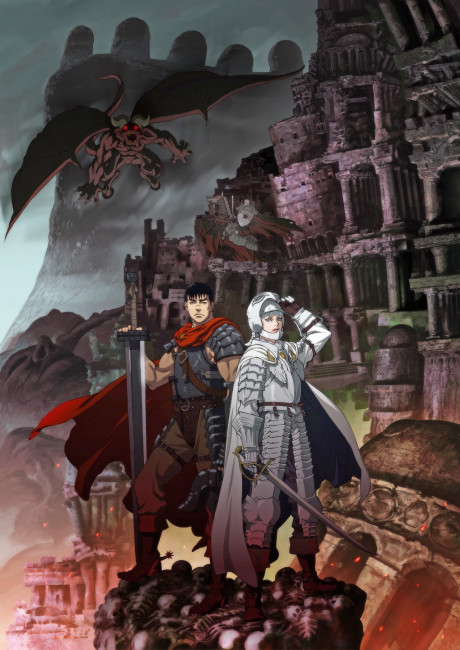
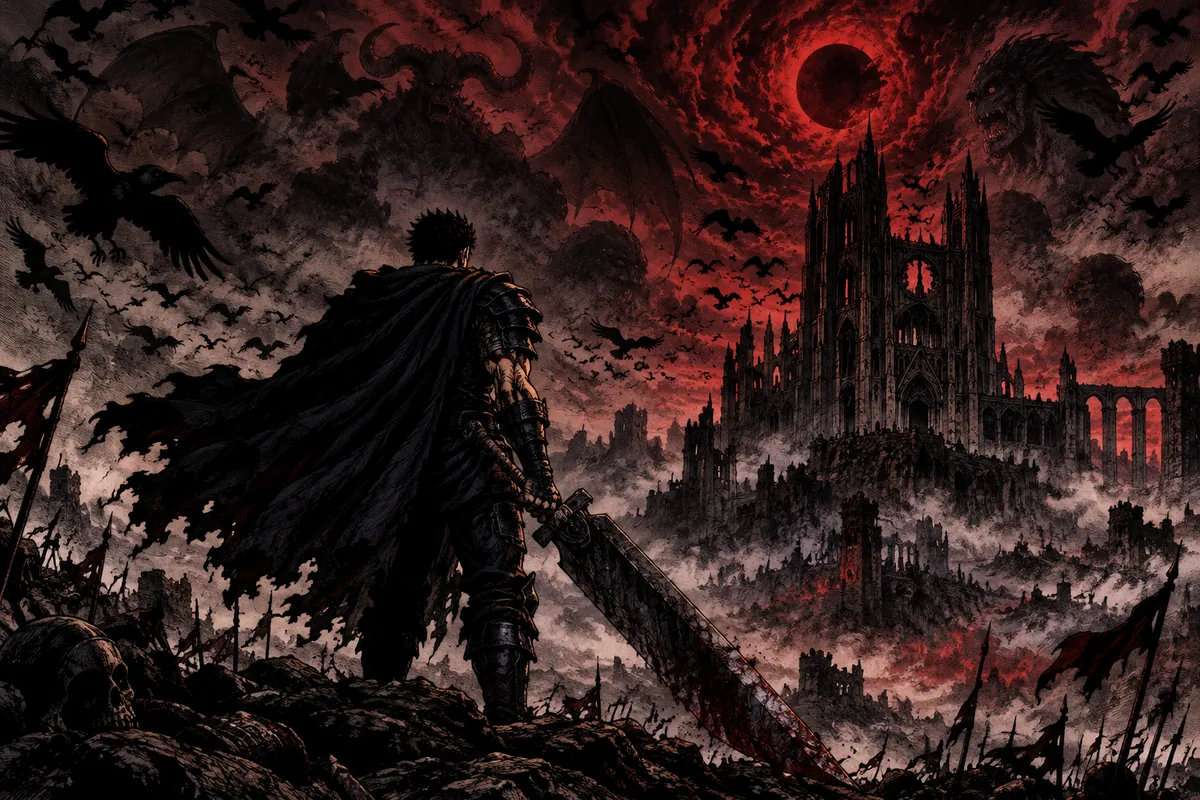
Image: Fan art (AI-generated)
What counts as dark fantasy here
Dark fantasy means a fantastical world where the horror is real and the heroes pay for everything: demons, curses, monsters and magic, but with bleak stakes and little comfort. Every pick below is tagged dark in our catalogue and also fantasy, horror or demons. Content notes are part of each entry.
Years are first-broadcast years. Our seinen hub covers the magazine side of this, and our genre index lets you filter the whole catalogue the same way. If you are unsure why so many of these come from adult-targeted magazines, read what seinen means.
Quick comparison
| Title | Year | Episodes | Intensity |
|---|---|---|---|
| Berserk | 1997 / 2012-13 / 2016-17 | 25 + 3 films + 24 | Extreme |
| Mononoke | 2007 | 12 | High (psychological) |
| Devilman Crybaby | 2018 | 10 | Extreme |
| Dorohedoro | 2020, 2026 | 12 + 11 | High |
| Dororo | 2019 | 24 | Moderate to high |
| Hellsing Ultimate | 2006-2012 | 10 OVAs | Extreme |
| Attack on Titan | 2013-2023 | 4 seasons | High |
| Tokyo Ghoul | 2014-2018 | 12 + 12 + 24 | High |
| The Promised Neverland | 2019, 2021 | 12 + 11 | Moderate |
| Fate/Zero | 2011-2012 | 25 | Moderate |
| Parasyte | 2014-2015 | 24 | High |
| Ajin: Demi-Human | 2016 | 13 + 13 | High |
| Akame ga Kill! | 2014 | 24 | High |
| Blood Blockade Battlefront | 2015, 2017 | 12 + 12 | Moderate |
The 14 best dark fantasy anime
1. Berserk (1997, 2012-2013 films and 2016)
25-episode TV series (1997 to 1998), a three-film trilogy (2012 to 2013) and a 2016 to 2017 series of 24 episodes in two seasons
This is the benchmark the rest of the genre gets measured against. Kentaro Miura's mercenary Guts, his giant sword and the Band of the Hawk anchor a story about ambition, friendship and what an unkind universe does to both. The anime exists in three versions that each cover the Golden Age differently, and none of them is the whole story.
Start with the 1997 series, directed by Naohito Takahashi at OLM, which adapts the Black Swordsman and Golden Age material and stops partway through the arc. The Golden Age Arc film trilogy from Studio 4°C is the compressed alternative, and the 2016 series from Liden Films picks up later in the story with a hybrid 2D and 3D look that critics split on. We do not repeat the full breakdown here: use the Berserk watch order, the arcs explained guide, and is Berserk finished for what is and is not adapted.
Best for: viewers who want the genre's defining tone and can live with an unfinished anime.
Content notes: graphic violence, gore, sexual violence and abuse in the Golden Age material, and severe psychological cruelty. This is the most extreme entry on the list.
2. Mononoke (2007)
12 episodes, Toei Animation, director Kenji Nakamura
Mononoke follows a wandering Medicine Seller who exorcises spirits by first uncovering their form, truth and regret. It is built from five self-contained arcs of two to three episodes each, and it is a spin-off of the 2006 anthology Ayakashi: Samurai Horror Tales. The look is its calling card: flat, paper-textured colors and ornate patterns that make the horror feel like a moving woodblock print.
The dread comes from grudges, cruelty and shame, not war. The visual style is divisive.
Best for: viewers who like horror anthologies and distinctive art direction over action.
Content notes: disturbing imagery, discussion of abuse, and some blood. More unsettling than gory.
3. Devilman Crybaby (2018)
10 episodes, Science Saru, director Masaaki Yuasa, Netflix original
Devilman Crybaby re-tells Go Nagai's landmark manga about a gentle boy who merges with a demon and becomes a hybrid warrior while demons surface across the world. It is a fast, ugly apocalypse in Yuasa's loose style.
Best for: viewers who want a complete, self-contained apocalyptic story in a weekend.
Content notes: graphic violence, sexual content, drug use and bleak themes. Common Sense Media has said its mature content goes beyond what is typical for adult-aimed anime, so check before you play.
4. Dorohedoro (2020, 2026)
Season 1: 12 episodes (2020); season 2: 11 episodes (April to May 2026); MAPPA, director Yuichiro Hayashi
Dorohedoro follows Caiman, a man with a reptile head and no memory of why, hunting the sorcerers who did it to him in a filthy, industrial slum. Q Hayashida's manga ended in September 2018 after 23 volumes, so the story is complete, and the second season (streamed April 1 to May 27, 2026) means the anime is moving again. A third season has been announced.
It is more of a punk-rock grotesque than a gothic tragedy,, and early episodes throw you in without explanation.
Best for: viewers who like their horror weird, funny and dirty.
Content notes: dismemberment, gore, body horror and constant bloody fights played for dark comedy.
5. Dororo (2019)
24 episodes, MAPPA and Tezuka Productions, director Kazuhiro Furuhashi
Dororo adapts Osamu Tezuka's manga as the second anime version, after a 1969 series. A swordsman born with 48 body parts taken by demons travels a war-torn Sengoku-style Japan to win them back, with a young thief at his side. It is the most accessible first dark fantasy: episodic and mournful rather than nihilistic.
Best for: viewers who want dark fantasy with real heart and a clear ending.
Content notes: violence, child endangerment and war atrocities, less graphic than most of this list.
6. Hellsing Ultimate (2006 to 2012)
10 OVA episodes across Satelight, Madhouse and Graphinica
Hellsing Ultimate is the loud, operatic end of the genre: a vampire working for a secret British organization, a gun-toting nun-priest rival and a Nazi remnant with a point to prove. It follows the manga far more closely than the 2001 TV series, which is why most fans skip that one.
The pitch is style and escalation. Release gaps were long, so production quality varies between episodes.
Best for: viewers who want vampires, gunfights and excess rather than subtlety.
Content notes: extreme gore, mass death and a gleeful tone toward violence.
7. Attack on Titan (2013 to 2023)
Four seasons across Wit Studio and MAPPA; the finale special aired on November 5, 2023
Attack on Titan starts as a siege horror story about walled-in humanity and turns into one of the biggest political war dramas anime has attempted. The first season is a survival thriller, then mysteries about the world drive the long game, and the last season changes what you thought the story was about.
Studio and director changes shift the look midway, and the ending still splits fans. No spoilers here.
Best for: viewers who want a long, plotted story and are comfortable with a controversial finish.
Content notes: graphic violence including on-screen deaths, war themes and some distressing scenes involving young characters.
8. Tokyo Ghoul (2014 to 2018)
12 episodes (2014), 12 episodes of Root A (2015), then Tokyo Ghoul:re in two 12-episode seasons (2018); Studio Pierrot
Tokyo Ghoul is urban horror: a student is turned partly into a flesh-eating ghoul and has to survive both species. The first season carries the strongest atmosphere. Be warned that the second season, Root A, follows an original story rather than the manga, and :re (directed by Toshinori Watanabe) compresses the sequel manga heavily.
Best for: viewers who like urban horror and tragic monsters, and are fine with an uneven anime.
Content notes: gore, torture, cannibalism and psychological abuse.
9. The Promised Neverland (2019, 2021)
12 episodes (2019) and 11 episodes (2021); CloverWorks, director Mamoru Kanbe
The Promised Neverland trades swords for wits. Orphans at a seemingly idyllic home discover what the adults really intend and plan an escape. The first season is a tense, near-perfect thriller. The second season is a compressed version of a much longer manga (chapters 38 to 181) and was widely criticized, so many fans stop after season one or switch to the manga for the rest.
Best for: viewers who like escape thrillers and want a short, near-complete first season.
Content notes: child characters in mortal danger, implied violence and a bleak premise. Little explicit gore.
10. Fate/Zero (2011 to 2012)
25 episodes in two seasons; ufotable, director Ei Aoki; story by Gen Urobuchi
Fate/Zero is a prequel to the Fate/stay night visual novel: seven mages summon legendary heroes to fight over a wish-granting grail. It is dark in what it asks of its characters, who are mostly adults with compromised ideals, and it is better as a war drama than as a fantasy spectacle.
The animation is excellent and the writing is very talky.
Best for: viewers who want adult characters, moral cost and top-tier animation.
Content notes: violence including against children, war themes and downbeat outcomes.
11. Parasyte: The Maxim (2014 to 2015)
24 episodes, Madhouse, director Kenichi Shimizu
Parasyte is dark fantasy at the science-fiction edge: alien parasites take over human heads, and a teenager ends up sharing his right hand with one. Hitoshi Iwaaki's manga ran from 1989 to 1994 in Monthly Afternoon, and the story is about empathy more than monsters.
Best for: viewers who want body horror with a thoughtful center.
Content notes: body horror, graphic deaths and gore.
12. Ajin: Demi-Human (2016)
Two 13-episode seasons, Polygon Pictures, streamed on Netflix in 2016
Ajin follows a boy who discovers he is an immortal "ajin" and becomes a government target. It is closer to thriller than fantasy, driven by a charismatic, ruthless antagonist, and it uses 3D animation that you will either accept in a few minutes or not at all.
The manga by Gamon Sakurai ran in Good! Afternoon until 2021, so the anime ends well before the manga does.
Best for: viewers who want a fast, grim thriller with a great villain.
Content notes: graphic violence, experimentation scenes and torture.
13. Akame ga Kill! (2014)
24 episodes, White Fox, director Tomoki Kobayashi
Akame ga Kill! sends a country boy to join an assassin group fighting a corrupt empire. It looks like a standard shonen action show for several episodes, and then it starts killing characters you thought were safe.
Best for: viewers who want fast fantasy action where no one is safe.
Content notes: graphic violence, on-screen deaths, torture and some sexualized fan service.
14. Blood Blockade Battlefront (2015, 2017)
Two 12-episode seasons, Bones; creator Yasuhiro Nightow
Blood Blockade Battlefront is the lightest pick: New York is now Hellsalem's Lot, a city on the edge of a portal to another dimension, and a secret organization keeps it from ending. It is stylish, fast and often funny.
Best for: viewers who want urban fantasy with action and a lighter hand.
Content notes: stylized violence and some monster horror. Mild next to the rest.
Where to start
- Want the genre's peak: Berserk, then Mononoke.
- Want something short and complete: Devilman Crybaby (10 episodes) or Mononoke (12).
- First dark fantasy and a gentler start: Dororo or Blood Blockade Battlefront.
Questions people ask
What are the top 10 dark fantasy anime?
Berserk, Mononoke, Devilman Crybaby, Dorohedoro, Dororo, Hellsing Ultimate, Attack on Titan, Tokyo Ghoul, The Promised Neverland and Fate/Zero make a strong top 10 from our list. Parasyte, Ajin, Akame ga Kill! and Blood Blockade Battlefront are close.
What is the best dark anime of all time?
There is no single answer, but Berserk is the usual pick for dark fantasy. Devilman Crybaby fits if you want a complete story in 10 episodes.
Is Berserk the darkest anime?
It is among the harshest, mostly because of its violence and abuse in the Golden Age material, but Devilman Crybaby and Hellsing Ultimate are comparable in graphic content. See the Berserk watch order before you start.
Which dark fantasy anime is best for beginners?
Dororo is gentle, episodic and has a clear ending. Blood Blockade Battlefront is lighter still.
Where do I find more adult-oriented dark anime?
Browse the seinen category and the genre index.
Sources
- Wikipedia, "Berserk (1997 TV series)", accessed 4 Nov 2026: https://en.wikipedia.org/wiki/Berserk_(1997_TV_series)
- Wikipedia, "Berserk (2016 TV series)", accessed 4 Nov 2026: https://en.wikipedia.org/wiki/Berserk_(2016_TV_series)
- Wikipedia, "Berserk: The Golden Age Arc", accessed 4 Nov 2026: https://en.wikipedia.org/wiki/Berserk:_The_Golden_Age_Arc
- Anime News Network, "Viz Media Licenses Berserk Film Trilogy", 7 Apr 2012: https://animenewsnetwork.com/news/2012-04-07/viz-media-licenses-berserk-film-trilogy
- Wikipedia, "Mononoke (TV series)", accessed 4 Nov 2026: https://en.wikipedia.org/wiki/Mononoke_(TV_series)
- Wikipedia, "Devilman Crybaby", accessed 4 Nov 2026: https://en.wikipedia.org/wiki/Devilman_Crybaby
- Wikipedia, "Dorohedoro", accessed 4 Nov 2026: https://en.wikipedia.org/wiki/Dorohedoro
- AniTrendz, "Dorohedoro Anime Series Gets 3rd Season", 27 May 2026: https://anitrendz.com/news/2026/05/27/dorohedoro-anime-series-gets-3rd-season/
- Wikipedia, "Dororo (2019 TV series)", accessed 4 Nov 2026: https://en.wikipedia.org/wiki/Dororo_(2019_TV_series)
- Wikipedia, "Hellsing Ultimate", accessed 4 Nov 2026: https://en.wikipedia.org/wiki/Hellsing_Ultimate
- Wikipedia, "Attack on Titan (TV series)", accessed 4 Nov 2026: https://en.wikipedia.org/wiki/Attack_on_Titan_(TV_series)
- Wikipedia, "Tokyo Ghoul", accessed 4 Nov 2026: https://en.wikipedia.org/wiki/Tokyo_Ghoul
- Wikipedia, "The Promised Neverland", accessed 4 Nov 2026: https://en.wikipedia.org/wiki/The_Promised_Neverland
- Wikipedia, "Fate/Zero", accessed 4 Nov 2026: https://en.wikipedia.org/wiki/Fate/Zero
- Wikipedia, "Parasyte", accessed 4 Nov 2026: https://en.wikipedia.org/wiki/Parasyte
- Wikipedia, "Ajin: Demi-Human", accessed 4 Nov 2026: https://en.wikipedia.org/wiki/Ajin:_Demi-Human
- Wikipedia, "Akame ga Kill!", accessed 4 Nov 2026: https://en.wikipedia.org/wiki/Akame_ga_Kill!
- Wikipedia, "Blood Blockade Battlefront", accessed 4 Nov 2026: https://en.wikipedia.org/wiki/Blood_Blockade_Battlefront
Last checked: 4 November 2026