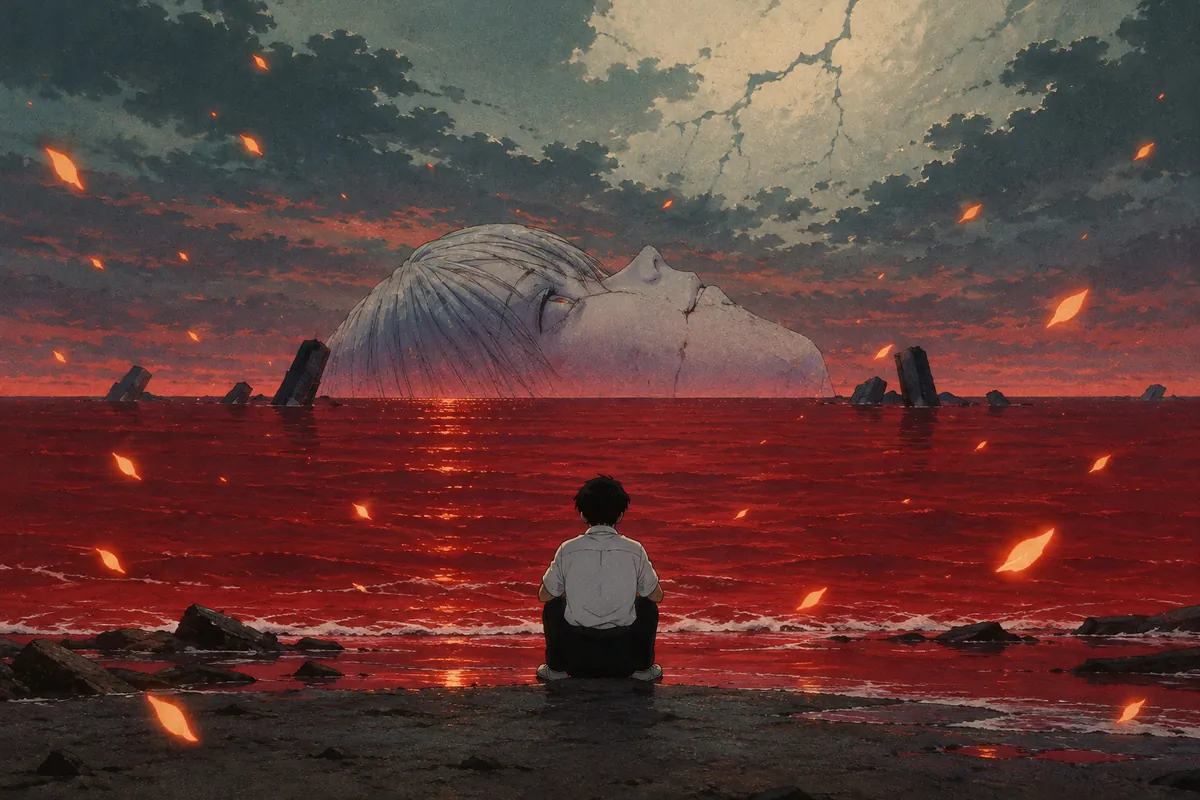
The End of Evangelion is a 1997 film (87 minutes) that replaces the last two episodes of the Neon Genesis Evangelion TV series with a new, more action-driven ending. It is not a sequel: watch episodes 1 to 24 first, then choose between TV episodes 25 and 26 or the film, or both. This guide explains what the film is, how it differs from the TV ending, and where Death & Rebirth and the Rebuild movies fit.
Image: Fan art (AI-generated)
Spoiler note: the first sections are spoiler-free. The section marked "Spoilers" explains the ending in plain terms. The film is for adults: it contains graphic violence and disturbing imagery.
What The End of Evangelion is
The End of Evangelion (Japanese title: Shinseiki Evangelion Gekijoban: Air / Magokoro wo, Kimi ni) opened in Japanese theaters on July 19, 1997. It was directed by Hideaki Anno and Kazuya Tsurumaki and made by Gainax and Production I.G.
The TV series ran from October 4, 1995 to March 27, 1996, with 26 episodes. Its last two episodes stay inside the characters' minds and use abstract animation. Many viewers were confused and asked for a clearer ending. Gainax announced a film in May 1996, and the film retells those final two episodes as events that actually happen in the world.
The film has two parts: "Air" (called Episode 25' in the film) and "Sincerely Yours" (Episode 26'). They match TV episode 25, "Do You Love Me?", and episode 26, "Take Care of Yourself". Gainax staff have said the dark tone was planned from the start and was not only a reaction to fan complaints.
You can find it in our catalogue as Neon Genesis Evangelion: The End of Evangelion. It is part of the wider mecha and psychological drama genre; see our mecha anime page for more.
Which ending should you watch?
You do not have to pick one for good. The TV ending and the film are two official versions of the same last stretch. Here is the short comparison.
| Version | Year | Length | What it is |
|---|---|---|---|
| TV episodes 25 and 26 | 1996 | 2 episodes | The original ending. It follows Shinji's thoughts and has very little action. |
| The End of Evangelion | 1997 | 87 min | An alternate ending that shows the same crisis as real events, with battles and a clear final image. |
| Rebuild of Evangelion | 2007 to 2021 | 4 films | A retelling that changes the story and has its own, new ending. |
A simple route for new viewers: finish episodes 1 to 24, watch the TV episodes 25 and 26, then watch The End of Evangelion. Seeing both makes it easier to understand what each one is trying to say. If you want only one, the film is the more direct story. For the full order of everything, read our Evangelion watch order.
Where Death & Rebirth fits
Death & Rebirth came out in March 1997, a few months before the film. Its first part, "Death", is a recap of the first 24 episodes with some new footage. Its second part, "Rebirth", is about 25 minutes long and works as a preview of the new ending. It was meant to be the first of two films.
The new footage in "Rebirth" reportedly became the opening part of The End of Evangelion. In 1998, Gainax combined the overlapping parts of the two films into a single release called Revival of Evangelion. If you have watched the TV series, you can skip Death & Rebirth and go straight to The End of Evangelion. Our catalogue has Death & Rebirth if you still want it.
Spoilers: what happens in The End of Evangelion
Spoiler warning: this section describes the plot and the ending.
The film begins with Shinji in despair after the events of the TV series. His friend Asuka is in a hospital in a coma. The opening hospital scene is the most discussed part of the film and is deeply disturbing. We do not describe it here.
Then SEELE, the secret group that has been directing NERV, decides to act. It sends military forces against NERV headquarters, because it wants to start the Human Instrumentality Project. The attack is brutal. Several main characters are killed, including Misato and Ritsuko, and Asuka's Unit-02 is destroyed by the mass-produced Evangelions.
Rei merges with Lilith, the Spear of Longinus is used, and the Third Impact begins. People's bodies turn into LCL, the orange liquid seen in the series, and their souls are joined together. Shinji is left to decide what to do with this world.
He considers a world with no one to hurt him, and then rejects it. He wants to meet other people again, even if that means pain. The film tells us that anyone who wants to return to a physical body can do so. The last scene shows Shinji and Asuka on a beach by a red sea. He starts to strangle her, stops when she touches his face, and breaks down crying. She says she feels sick, and the film ends.
That final scene has no single accepted explanation. Many fans read it as a hard but honest ending: living with other people is difficult, and the film does not claim it will become easy.
What is the Third Impact?
In the series, Third Impact is the event that brings the Human Instrumentality Project to completion. In the film, it is the moment where Lilith and the Spear of Longinus are used and the world changes. It is a catastrophe for the planet and also a very personal event for Shinji.
In short: Third Impact is the physical event, and Instrumentality is what it is meant to achieve.
What is the Human Instrumentality Project?
It is SEELE's plan to merge all humans into one shared consciousness, so that no one is separate or lonely. In the film, it works: bodies dissolve and souls join. The film's point is that Shinji can choose to leave that state and return to being an individual. The barriers (called AT Fields in the series) that keep people apart are what let each person exist as themselves.
How does the film relate to Rebuild of Evangelion?
Rebuild of Evangelion is a separate four-film retelling by Studio Khara with Hideaki Anno as chief director. The films came out on September 1, 2007; June 27, 2009; November 17, 2012; and March 8, 2021. The first film follows episodes 1 to 6 closely. From the second film, the story starts to change, and the third film breaks from the original story entirely.
The Rebuild ending, in Evangelion: 3.0+1.0 Thrice Upon a Time, is its own conclusion and is not the same as The End of Evangelion, although it refers to it. If you want to follow the Rebuild films, they are in our catalogue: 1.0, 2.0, 3.0 and the special 3.0 (-46h). You can also see the original Neon Genesis Evangelion series page.
Where to watch
Netflix announced in 2019 that it would carry the 26-episode series together with Death & Rebirth and The End of Evangelion. Availability varies by region, and titles move between services, so check the service pages in your country before you plan a viewing.
The film also returns to theaters sometimes. GKIDS announced a two-night North American release of Death (True)2 & Rebirth and The End of Evangelion for July 21 and 22, 2026.
Questions people ask
What happened in the original Evangelion ending?
In TV episodes 25 and 26, Shinji's mind goes through the Instrumentality process and he learns that he needs other people. The story stays inside the characters' thoughts. The End of Evangelion shows the same crisis as real events.
Is The End of Evangelion canon?
It is an official alternate ending to the TV series, made by the same director, so it counts as part of the story. It is described as both a remake of the last two episodes and an alternate ending. It is not part of the separate Rebuild continuity.
Do I need to watch the TV ending before the film?
You should watch episodes 1 to 24 first. Episodes 25 and 26 are not required, but watching them first helps you see how the film changes things.
Did Shinji and Asuka marry?
No. The film ends on a beach with the two of them alive, and nothing in it shows a marriage or a relationship.
Is The End of Evangelion on Netflix?
Netflix announced it as part of the 2019 launch of the series. Availability varies by region, so check your local Netflix catalogue.
How long is The End of Evangelion?
The film runs 87 minutes.
Sources
- Wikipedia, "The End of Evangelion" (release date July 19, 1997, runtime, plot, box office of 2.47 billion yen): en.wikipedia.org/wiki/The_End_of_Evangelion
- Wikipedia, "Neon Genesis Evangelion" (TV dates, episodes 25 and 26, Death & Rebirth release, production notes): en.wikipedia.org/wiki/Neon_Genesis_Evangelion
- Wikipedia, "Rebuild of Evangelion" (four films and release dates): en.wikipedia.org/wiki/Rebuild_of_Evangelion
- GKIDS, "GKIDS to Release EVANGELION 30th Movie Fest in North American Theatres July 21st & 22nd Only", June 25, 2026: gkids.com
- Engadget, "Neon Genesis Evangelion comes to Netflix June 21st", March 22, 2019: engadget.com
- EvaGeeks, "Neon Genesis Evangelion Coming To Netflix", November 2018: evageeks.org
Last checked: 5 November 2026